What Is One Way Woolf Actively Tries to Connect With Her Audience?
6.ane Purpose, Audition, Tone, and Content
Learning Objectives
- Identify the four common academic purposes.
- Identify audience, tone, and content.
- Utilise purpose, audience, tone, and content to a specific consignment.
Imagine reading one long block of text, with each idea blurring into the next. Even if you are reading a thrilling novel or an interesting news article, y'all will likely lose interest in what the author has to say very apace. During the writing procedure, information technology is helpful to position yourself equally a reader. Enquire yourself whether yous tin focus easily on each point you make. One technique that effective writers use is to brainstorm a fresh paragraph for each new idea they introduce.
Paragraphs divide ideas into logical, manageable chunks. I paragraph focuses on merely one main idea and presents coherent sentences to support that one point. Considering all the sentences in one paragraph back up the same point, a paragraph may stand up on its own. To create longer assignments and to talk over more than than one betoken, writers group together paragraphs.
Three elements shape the content of each paragraph:
- Purpose . The reason the writer composes the paragraph.
- Tone . The attitude the writer conveys most the paragraph's bailiwick.
- Audience . The individual or group whom the writer intends to address.
Effigy 6.1 Purpose, Audience, Tone, and Content Triangle
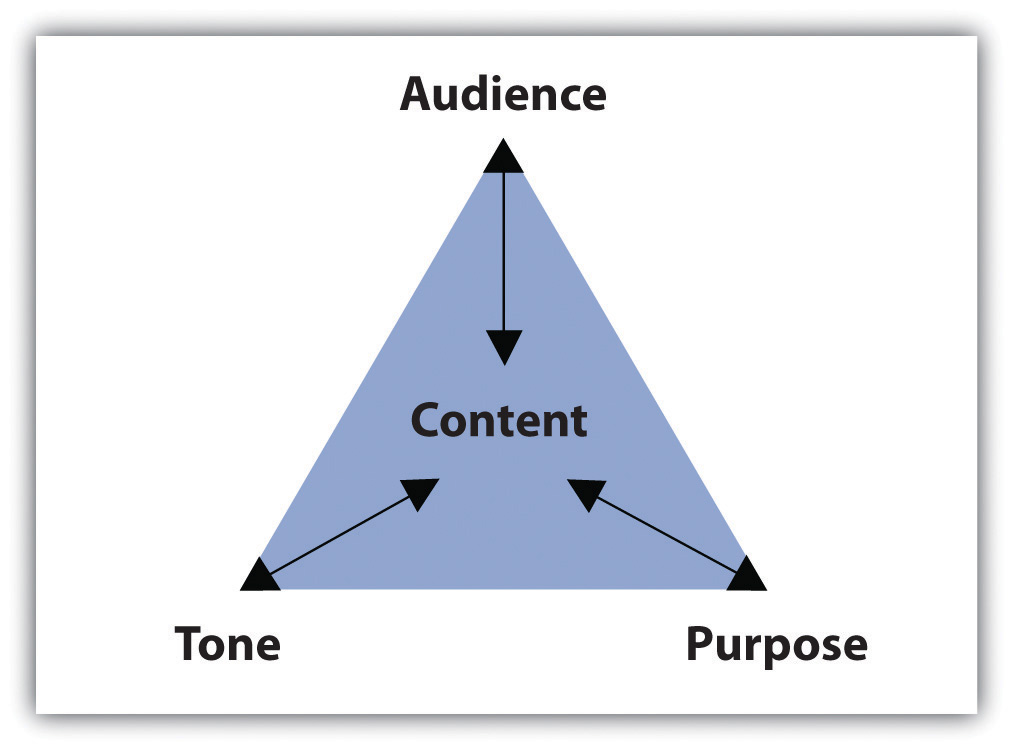
The consignment'due south purpose, audience, and tone dictate what the paragraph covers and how it will support one main point. This section covers how purpose, audition, and tone affect reading and writing paragraphs.
Identifying Common Academic Purposes
The purpose for a slice of writing identifies the reason you write a particular document. Basically, the purpose of a piece of writing answers the question "Why?" For instance, why write a play? To entertain a packed theater. Why write instructions to the bodyguard? To inform him or her of your schedule and rules. Why write a alphabetic character to your congressman? To persuade him to address your customs's needs.
In academic settings, the reasons for writing fulfill iv main purposes: to summarize, to analyze, to synthesize, and to evaluate. You will encounter these four purposes not simply as yous read for your classes merely besides as you read for work or pleasure. Because reading and writing piece of work together, your writing skills will ameliorate every bit yous read. To learn more about reading in the writing process, encounter Chapter 8 "The Writing Process: How Do I Brainstorm?".
Somewhen, your instructors volition ask you lot to complete assignments specifically designed to meet i of the four purposes. As you will run across, the purpose for writing will guide you through each part of the paper, helping yous make decisions about content and mode. For now, identifying these purposes by reading paragraphs volition prepare you to write individual paragraphs and to build longer assignments.
Summary Paragraphs
A summary shrinks a large corporeality of information into only the essentials. You probably summarize events, books, and movies daily. Remember about the terminal blockbuster movie you saw or the final novel you read. Chances are, at some point in a casual conversation with a friend, coworker, or classmate, you lot compressed all the action in a ii-hour film or in a ii-hundred-page book into a brief description of the major plot movements. While in conversation, you probably described the major highlights, or the chief points in simply a few sentences, using your own vocabulary and mode of speaking.
Similarly, a summary paragraph condenses a long slice of writing into a smaller paragraph by extracting only the vital information. A summary uses only the writer'due south ain words. Like the summary's purpose in daily conversation, the purpose of an academic summary paragraph is to maintain all the essential information from a longer certificate. Although shorter than the original slice of writing, a summary should still communicate all the key points and key support. In other words, summary paragraphs should be succinct and to the indicate.
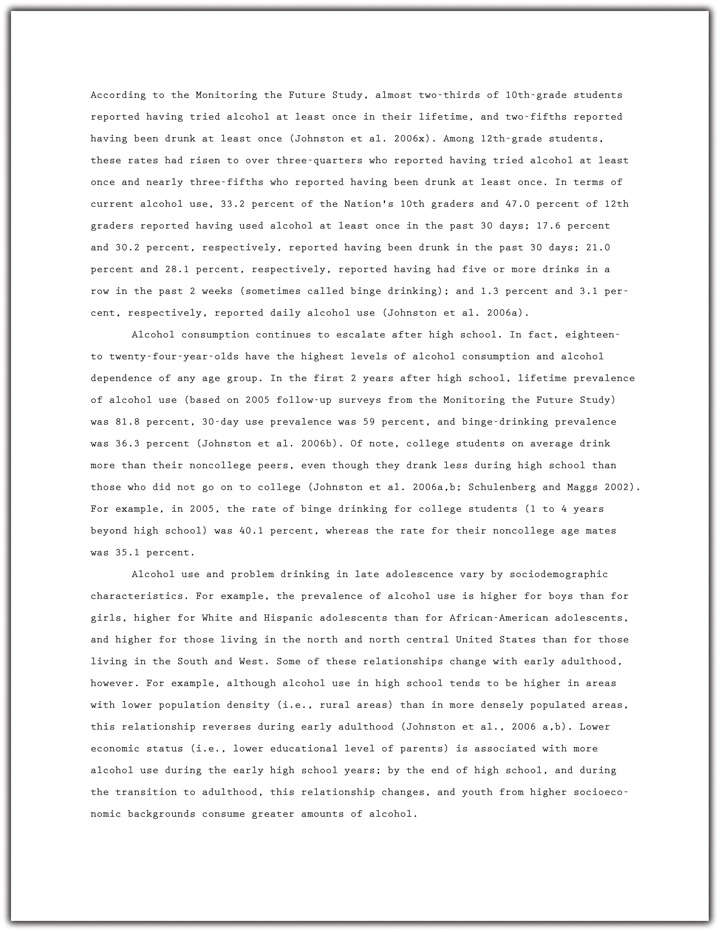
A summary of the report should present all the main points and supporting details in brief. Read the following summary of the report written by a pupil:
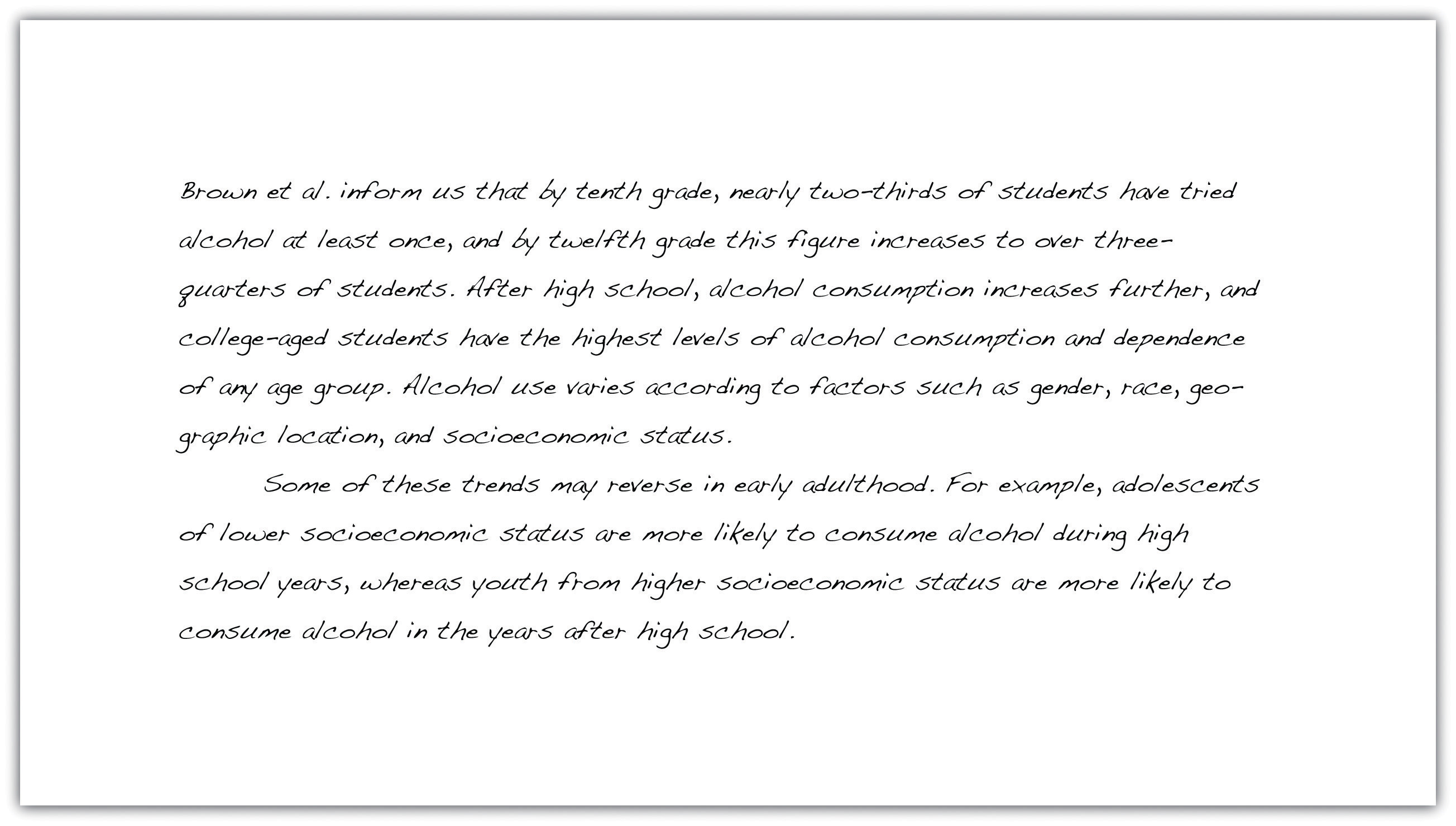
Observe how the summary retains the key points made by the writers of the original written report merely omits near of the statistical data. Summaries need not contain all the specific facts and figures in the original certificate; they provide simply an overview of the essential data.
Analysis Paragraphs
An analysis separates circuitous materials in their different parts and studies how the parts relate to one some other. The analysis of simple salt, for instance, would require a deconstruction of its parts—the elements sodium (Na) and chloride (Cl). And then, scientists would written report how the two elements interact to create the chemical compound NaCl, or sodium chloride, which is likewise called simple table salt.
Assay is not limited to the sciences, of form. An analysis paragraph in bookish writing fulfills the same purpose. Instead of deconstructing compounds, academic analysis paragraphs typically deconstruct documents. An analysis takes apart a primary source (an essay, a book, an commodity, etc.) point by point. It communicates the primary points of the certificate past examining individual points and identifying how the points relate to one another.
Take a wait at a student'due south assay of the periodical report.
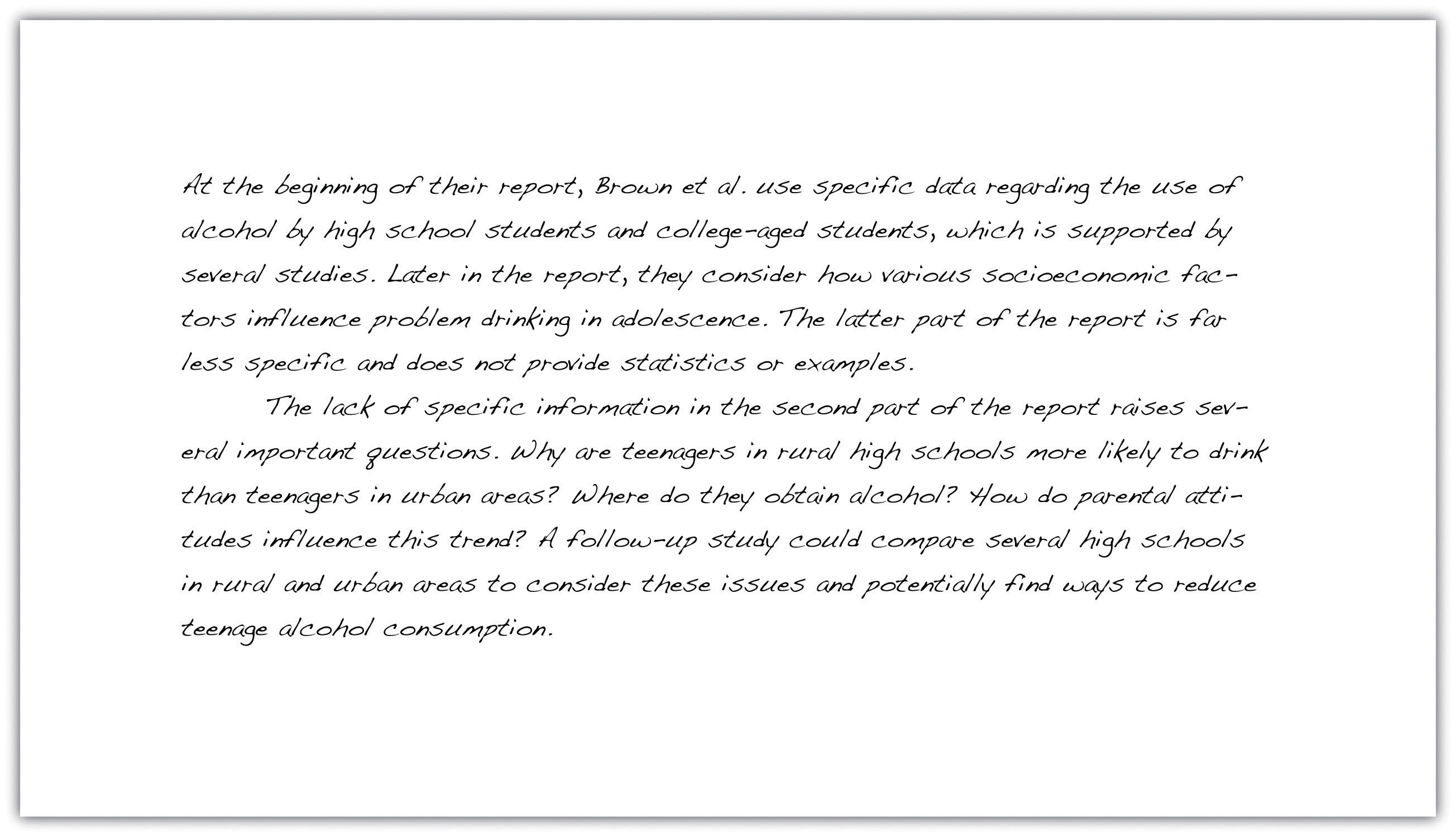
Notice how the assay does not only repeat information from the original study, but considers how the points within the written report relate to one another. Past doing this, the pupil uncovers a discrepancy between the points that are backed up past statistics and those that require boosted information. Analyzing a document involves a close examination of each of the private parts and how they work together.
Synthesis Paragraphs
A synthesis combines two or more items to create an entirely new item. Consider the electronic musical instrument aptly named the synthesizer. It looks like a uncomplicated keyboard but displays a dashboard of switches, buttons, and levers. With the flip of a few switches, a musician may combine the singled-out sounds of a pianoforte, a flute, or a guitar—or any other combination of instruments—to create a new sound. The purpose of the synthesizer is to blend together the notes from private instruments to form new, unique notes.
The purpose of an bookish synthesis is to blend individual documents into a new document. An academic synthesis paragraph considers the primary points from one or more than pieces of writing and links the main points together to create a new betoken, one non replicated in either document.
Accept a await at a student's synthesis of several sources well-nigh underage drinking.
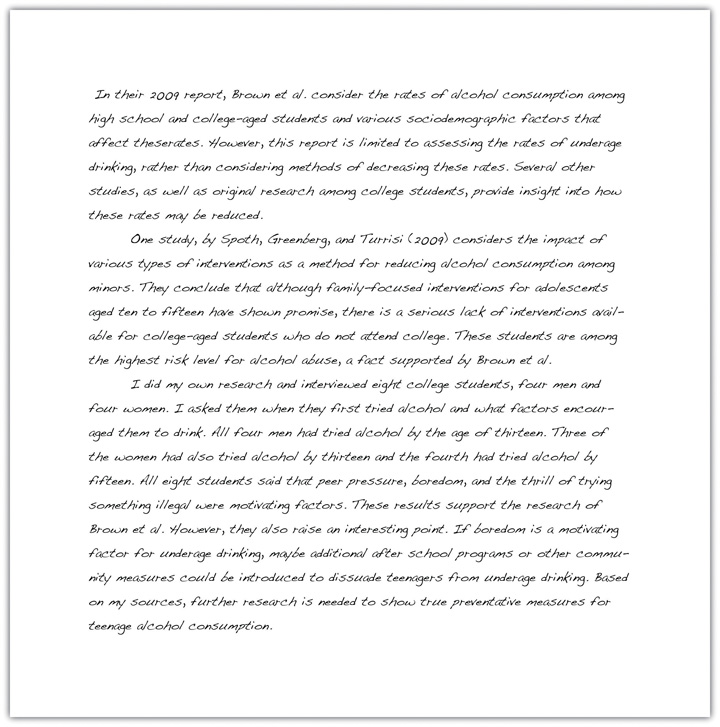
Notice how the synthesis paragraphs consider each source and utilise data from each to create a new thesis. A good synthesis does not repeat data; the author uses a variety of sources to create a new idea.
Evaluation Paragraphs
An evaluation judges the value of something and determines its worth. Evaluations in everyday experiences are often non but dictated past set standards but also influenced by opinion and prior knowledge. For example, at work, a supervisor may complete an employee evaluation by judging his subordinate'southward functioning based on the company's goals. If the company focuses on improving communication, the supervisor will rate the employee's customer service according to a standard calibration. Notwithstanding, the evaluation still depends on the supervisor'due south stance and prior feel with the employee. The purpose of the evaluation is to decide how well the employee performs at his or her job.
An bookish evaluation communicates your opinion, and its justifications, about a document or a topic of word. Evaluations are influenced by your reading of the document, your prior knowledge, and your prior experience with the topic or issue. Considering an evaluation incorporates your point of view and reasons for your betoken of view, it typically requires more disquisitional thinking and a combination of summary, analysis, and synthesis skills. Thus evaluation paragraphs often follow summary, analysis, and synthesis paragraphs. Read a educatee's evaluation paragraph.
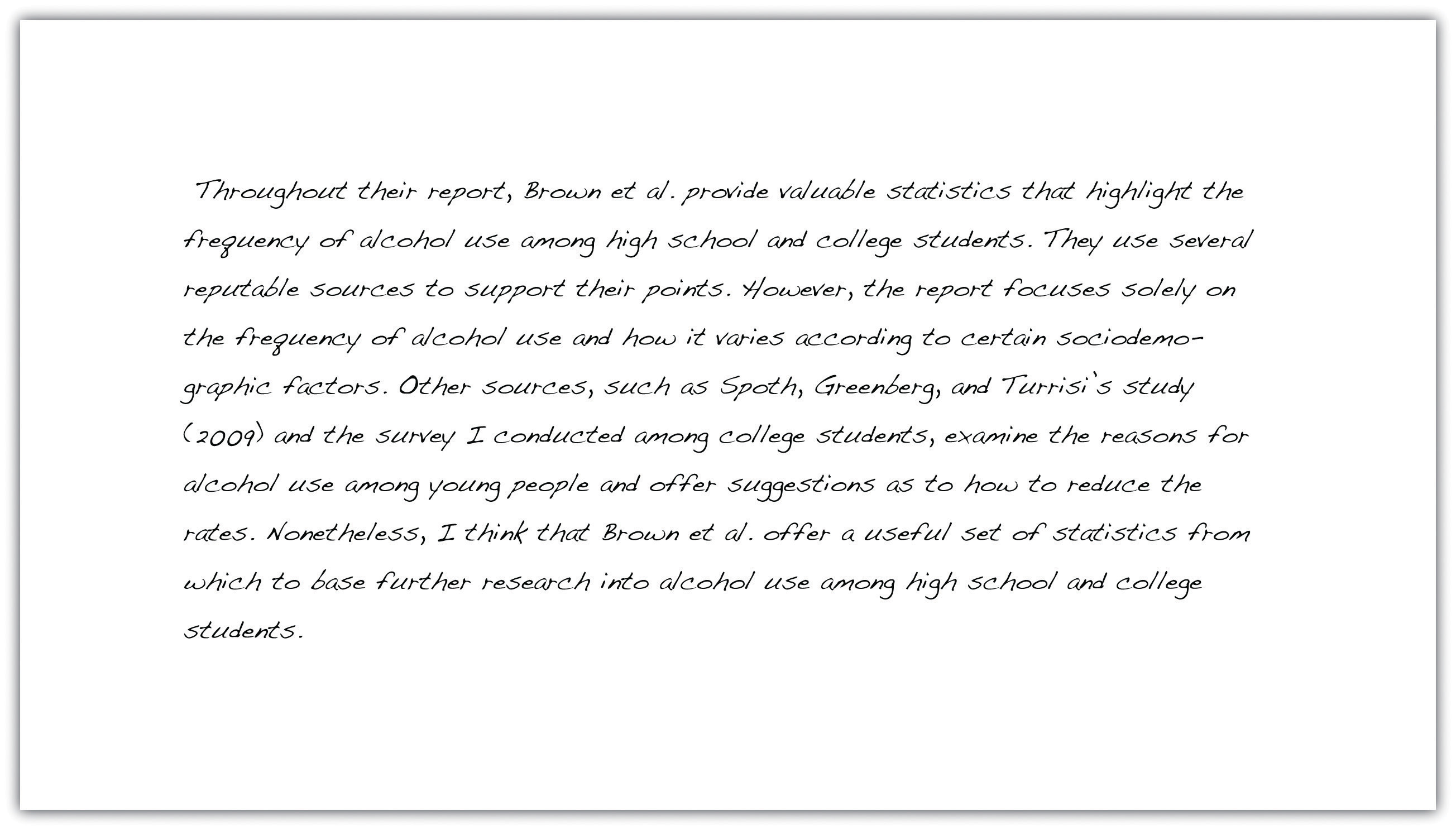
Discover how the paragraph incorporates the student's personal judgment within the evaluation. Evaluating a certificate requires prior knowledge that is often based on boosted inquiry.
Tip
When reviewing directions for assignments, look for the verbs summarize, analyze, synthesize, or evaluate. Instructors ofttimes utilise these words to conspicuously indicate the consignment'due south purpose. These words will cue y'all on how to consummate the consignment considering you volition know its exact purpose.
Practise 1
Read the following paragraphs about iv films so identify the purpose of each paragraph.
- This movie could easily take been cut downward to less than two hours. By the final scene, I noticed that almost of my fellow moviegoers were snoozing in their seats and were barely paying attention to what was happening on screen. Although the managing director sticks diligently to the book, he tries too hard to cram in all the activeness, which is just besides ambitious for such a detail-oriented story. If you want my advice, read the book and give the movie a miss.
- During the opening scene, we acquire that the character Laura is adopted and that she has spent the by three years desperately trying to track downward her real parents. Having wearied all the usual options—adoption agencies, online searches, family trees, and then on—she is on the verge of giving up when she meets a stranger on a passenger vehicle. The chance encounter leads to a complicated chain of events that ultimately result in Laura getting her lifelong wish. Merely is it really what she wants? Throughout the rest of the film, Laura discovers that sometimes the past is best left where information technology belongs.
- To create the feeling of being gripped in a vice, the director, May Lee, uses a variety of elements to gradually increase the tension. The creepy, haunting melody that subtly enhances the before scenes becomes e'er more insistent, ascent to a disturbing crescendo toward the end of the movie. The agony of the actors, combined with the claustrophobic temper and tight camera angles create a realistic firestorm, from which there is little hope of escape. Walking out of the theater at the end feels like staggering out of a Roman dungeon.
- The scene in which Campbell and his young man prisoners assist the guards in shutting down the riot immediately strikes the viewer every bit unrealistic. Based on the recent reports on prison riots in both Detroit and California, it seems highly unlikely that a posse of hardened criminals will intentionally help their captors at the adventure of inciting futurity revenge from other inmates. Instead, both news reports and psychological studies indicate that prisoners who do not actively participate in a riot will get back to their cells and avoid conflict altogether. Examples of this lack of attention to item occur throughout the film, making information technology virtually unbearable to picket.
Collaboration
Share with a classmate and compare your answers.
Writing at Piece of work
Thinking about the purpose of writing a report in the workplace can help focus and structure the document. A summary should provide colleagues with a factual overview of your findings without going into too much specific detail. In contrast, an evaluation should include your personal opinion, forth with supporting show, research, or examples to dorsum it up. Listen for words such equally summarize, analyze, synthesize, or evaluate when your dominate asks y'all to consummate a study to assist determine a purpose for writing.
Exercise 2
Consider the essay most recently assigned to yous. Identify the almost effective academic purpose for the assignment.
My assignment: ____________________________________________
My purpose: ____________________________________________
Identifying the Audition
Imagine you must give a presentation to a group of executives in an role. Weeks before the big twenty-four hours, you spend time creating and rehearsing the presentation. You lot must brand important, careful decisions not only about the content but also well-nigh your delivery. Volition the presentation require engineering to project figures and charts? Should the presentation define important words, or will the executives already know the terms? Should you wear your adapt and apparel shirt? The answers to these questions volition assist you develop an advisable relationship with your audience, making them more receptive to your message.
At present imagine y'all must explain the same business concepts from your presentation to a grouping of high school students. Those of import questions you previously answered may at present require different answers. The figures and charts may be too sophisticated, and the terms will certainly crave definitions. Yous may fifty-fifty reconsider your outfit and sport a more casual wait. Considering the audience has shifted, your presentation and delivery will shift as well to create a new relationship with the new audience.
In these 2 situations, the audition—the individuals who will watch and listen to the presentation—plays a role in the evolution of presentation. Equally yous prepare the presentation, you visualize the audition to anticipate their expectations and reactions. What you imagine affects the information you choose to present and how you lot will present it. And so, during the presentation, you encounter the audience in person and notice immediately how well you perform.
Although the audience for writing assignments—your readers—may not announced in person, they play an as vital role. Even in everyday writing activities, you identify your readers' characteristics, interests, and expectations earlier making decisions most what you lot write. In fact, thinking most audience has become so mutual that you may non even detect the audition-driven decisions.
For example, y'all update your status on a social networking site with the sensation of who will digitally follow the post. If you want to brag nigh a good class, you may write the post to please family unit members. If yous want to describe a funny moment, you may write with your friends' senses of sense of humor in heed. Fifty-fifty at work, you lot send e-mails with an sensation of an unintended receiver who could intercept the message.
In other words, beingness aware of "invisible" readers is a skill you most likely already possess and one y'all rely on every twenty-four hour period. Consider the post-obit paragraphs. Which ane would the author send to her parents? Which ane would she send to her all-time friend?
Instance A
Concluding Saturday, I volunteered at a local hospital. The visit was fun and rewarding. I fifty-fifty learned how to do cardiopulmonary resuscitation, or CPR. Unfortunately, I recollect defenseless a common cold from one of the patients. This calendar week, I will rest in bed and potable plenty of articulate fluids. I hope I am well by next Sabbatum to volunteer again.
Example B
OMG! Yous won't believe this! My advisor forced me to do my community service hours at this hospital all weekend! We learned CPR but we did it on dummies, non even real peeps. And some kid sneezed on me and got me sick! I was so bored and sniffling all weekend; I promise I don't take to go back next week. I def practice NOT desire to miss the basketball tournament!
Most probable, you matched each paragraph to its intended audience with little hesitation. Because each paragraph reveals the author's human relationship with her intended readers, you can identify the audience fairly quickly. When writing your own paragraphs, you must engage with your audience to build an appropriate relationship given your subject. Imagining your readers during each stage of the writing process will aid you brand decisions about your writing. Ultimately, the people you lot visualize volition impact what and how you lot write.
Tip
While giving a speech, y'all may articulate an inspiring or disquisitional message, but if you left your hair a mess and laced up mismatched shoes, your audience would non take you lot seriously. They may be too distracted by your appearance to listen to your words.
Similarly, grammar and sentence construction serve as the advent of a slice of writing. Polishing your piece of work using correct grammar will print your readers and allow them to focus on what you have to say.
Because focusing on audience will enhance your writing, your procedure, and your finished production, you must consider the specific traits of your audience members. Use your imagination to conceptualize the readers' demographics, education, prior knowledge, and expectations.
- Demographics. These measure important data about a grouping of people, such as their age range, their ethnicity, their religious beliefs, or their gender. Certain topics and assignments will require these kinds of considerations about your audience. For other topics and assignments, these measurements may not influence your writing in the end. Regardless, it is important to consider demographics when you begin to think about your purpose for writing.
- Teaching. Education considers the audition's level of schooling. If audience members have earned a doctorate caste, for example, you may need to drag your style and use more formal language. Or, if audience members are nonetheless in higher, y'all could write in a more relaxed manner. An audience member's major or emphasis may also dictate your writing.
- Prior knowledge. This refers to what the audience already knows about your topic. If your readers have studied certain topics, they may already know some terms and concepts related to the topic. You may decide whether to define terms and explain concepts based on your audience'due south prior noesis. Although you cannot peer inside the brains of your readers to discover their cognition, you lot can make reasonable assumptions. For instance, a nursing major would presumably know more nearly health-related topics than a business major would.
- Expectations. These indicate what readers will look for while reading your assignment. Readers may look consistencies in the assignment's appearance, such as correct grammar and traditional formatting similar double-spaced lines and legible font. Readers may also have content-based expectations given the consignment's purpose and organization. In an essay titled "The Economics of Enlightenment: The Effects of Rising Tuition," for instance, audience members may look to read almost the economical repercussions of college tuition costs.
Exercise three
On your ain sheet of newspaper, generate a list of characteristics nether each category for each audience. This list volition help you later when you lot read nigh tone and content.
1. Your classmates
- Demographics ____________________________________________
- Education ____________________________________________
- Prior noesis ____________________________________________
- Expectations ____________________________________________
ii. Your instructor
- Demographics ____________________________________________
- Education ____________________________________________
- Prior knowledge ____________________________________________
- Expectations ____________________________________________
three. The head of your academic department
- Demographics ____________________________________________
- Pedagogy ____________________________________________
- Prior knowledge ____________________________________________
- Expectations ____________________________________________
4. Now think about your next writing consignment. Identify the purpose (you may use the same purpose listed in Note vi.12 "Exercise 2"), and then place the audience. Create a listing of characteristics under each category.
My assignment: ____________________________________________
My purpose: ____________________________________________
My audience: ____________________________________________
- Demographics ____________________________________________
- Teaching ____________________________________________
- Prior cognition ____________________________________________
- Expectations ____________________________________________
Collaboration
Please share with a classmate and compare your answers.
Keep in mind that equally your topic shifts in the writing procedure, your audience may likewise shift. For more information about the writing process, run into Chapter 8 "The Writing Process: How Do I Begin?".
Also, remember that decisions near style depend on audition, purpose, and content. Identifying your audience's demographics, pedagogy, prior knowledge, and expectations will touch on how you write, but purpose and content play an equally important part. The next subsection covers how to select an appropriate tone to friction match the audience and purpose.
Selecting an Advisable Tone
Tone identifies a speaker'south attitude toward a subject area or another person. You may choice upwardly a person's tone of voice fairly easily in chat. A friend who tells you about her weekend may speak excitedly well-nigh a fun skiing trip. An instructor who means business may speak in a low, tiresome voice to emphasize her serious mood. Or, a coworker who needs to allow off some steam after a long meeting may scissure a sarcastic joke.
Just equally speakers transmit emotion through voice, writers can transmit through writing a range of attitudes, from excited and humorous to somber and disquisitional. These emotions create connections among the audience, the writer, and the subject, ultimately building a relationship between the audience and the text. To stimulate these connections, writers intimate their attitudes and feelings with useful devices, such as judgement construction, word selection, punctuation, and formal or informal language. Keep in mind that the writer's attitude should always accordingly match the audience and the purpose.
Read the post-obit paragraph and consider the writer's tone. How would you describe the writer's mental attitude toward wildlife conservation?
Many species of plants and animals are disappearing right before our eyes. If nosotros don't human action fast, it might be too tardily to salvage them. Human activities, including pollution, deforestation, hunting, and overpopulation, are devastating the natural environment. Without our help, many species will not survive long enough for our children to see them in the wild. Take the tiger, for example. Today, tigers occupy only 7 percent of their historical range, and many local populations are already extinct. Hunted for their beautiful pelt and other torso parts, the tiger population has plummeted from ane hundred chiliad in 1920 to just a few thou. Contact your local wildlife conservation society today to find out how you can cease this terrible devastation.
Exercise 4
Think about the assignment and purpose you selected in Notation 6.12 "Exercise 2", and the audience you selected in Note 6.16 "Exercise 3". Now, identify the tone you would use in the consignment.
My assignment: ____________________________________________
My purpose: ____________________________________________
My audience: ____________________________________________
My tone: ____________________________________________
Choosing Appropriate, Interesting Content
Content refers to all the written substance in a document. After selecting an audition and a purpose, you must choose what information volition make it to the page. Content may consist of examples, statistics, facts, anecdotes, testimonies, and observations, simply no matter the type, the data must exist advisable and interesting for the audience and purpose. An essay written for third graders that summarizes the legislative process, for case, would accept to incorporate succinct and simple content.
Content is as well shaped past tone. When the tone matches the content, the audience will be more engaged, and you will build a stronger relationship with your readers. Consider that audience of third graders. Yous would cull simple content that the audience volition easily empathize, and you lot would express that content through an enthusiastic tone. The same considerations apply to all audiences and purposes.
Exercise 5
Match the content in the box to the appropriate audience and purpose. On your own sheet of newspaper, write the correct alphabetic character next to the number.
- Whereas economist Holmes contends that the financial crisis is far from over, the presidential advisor Jones points out that it is vital to catch the first wave of opportunity to increment market share. Nosotros can use elements of both experts' visions. Allow me explain how.
- In 2000, foreign coin flowed into the United States, contributing to easy credit conditions. People bought larger houses than they could afford, eventually defaulting on their loans equally interest rates rose.
- The Emergency Economic Stabilization Deed, known past most of us equally the humungous government bailout, caused mixed reactions. Although supported by many political leaders, the statute provoked outrage among grassroots groups. In their opinion, the government was actually rewarding banks for their bloodcurdling beliefs.
-
Audition: An teacher
Purpose: To analyze the reasons backside the 2007 fiscal crisis
Content: ____________________________________________
-
Audience: Classmates
Purpose: To summarize the effects of the $700 billion government bailout
Content: ____________________________________________
-
Audience: An employer
Purpose: To synthesize two articles on preparing businesses for economical recovery
Content: ____________________________________________
Collaboration
Please share with a classmate and compare your answers.
Exercise 6
Using the assignment, purpose, audience, and tone from Notation 6.18 "Exercise 4", generate a list of content ideas. Remember that content consists of examples, statistics, facts, anecdotes, testimonies, and observations.
My consignment: ____________________________________________
My purpose: ____________________________________________
My audition: ____________________________________________
My tone: ____________________________________________
My content ideas: ____________________________________________
Key Takeaways
- Paragraphs carve up ideas into logical, manageable chunks of information.
- The content of each paragraph and certificate is shaped past purpose, audience, and tone.
- The four mutual academic purposes are to summarize, to analyze, to synthesize, and to evaluate.
- Identifying the audition's demographics, instruction, prior knowledge, and expectations will affect how and what you write.
- Devices such equally sentence structure, word choice, punctuation, and formal or informal language communicate tone and create a relationship betwixt the writer and his or her audience.
- Content may consist of examples, statistics, facts, anecdotes, testimonies, and observations. All content must be appropriate and interesting for the audience, purpose and tone.
Source: https://open.lib.umn.edu/writingforsuccess/chapter/6-1-purpose-audience-tone-and-content/
0 Response to "What Is One Way Woolf Actively Tries to Connect With Her Audience?"
Post a Comment