In these anxious times, what can we learn from 'the world’s happiest man'?
Advertising
People
In these anxious times, what can we learn from 'the world's happiest man'?
Matthieu Ricard, the Dalai Lama's French interpreter, spent 5 years of his life in contemplative retreat in the Himalayas. His advice for the residue of us: Make peace with your mind.
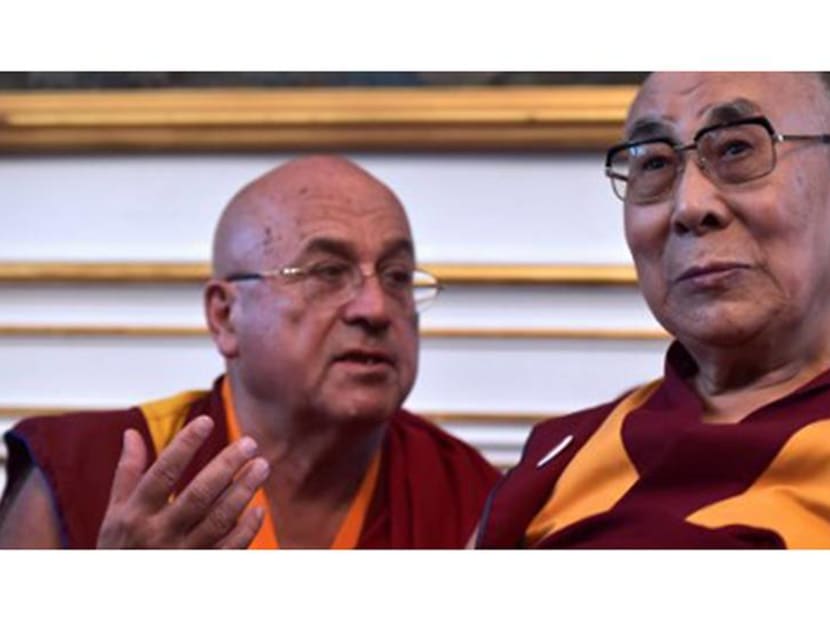
Tibetan Spiritual leader, the Dalai Lama, listens to his translator, French Buddhist monk Matthieu Ricard. (Photo: AFP/Patrick Hertzog)
After so long under lockdown, what ameliorate luncheon companion than the "happiest homo in the earth"? Matthieu Ricard pops up on my iPhone screen, instantly recognisable by his warm smiling and night red and orange monastic robes.
The 74-year-quondam biologist-turned-Buddhist, the French interpreter to the Dalai Lama, gained the epithet – which, by the way, he thinks absurd – in the 2000s, afterward taking part in a 12-year written report on the long-term impact of meditation. Through decades of training, he was constitute to have significantly contradistinct the construction of his brain. The results sent camera crews rushing to the Himalayas to notice his surreptitious (spoiler alert: There isn't one – it'due south a lifetime of hard work). And it later led the media to christen him "the world's happiest man".
Ricard is the ideal guest for these anxious times. He has an intimate knowledge of solitude, having spent a total of five years of his life in contemplative retreat. He's the starting time to admit that "confinement, of grade, for me it's a wonderful matter". His advice for the rest of us? "Brand peace with your own mind . . . and then the time will not feel and so heavy and then difficult."
In a nod to Ricard's stints in retreat, I have come to a remote sanctuary of my own: A pocket-size hut in the hills virtually my domicile in south-due west Scotland. Information technology is roughly the same size every bit the three-metre-square refuge in Nepal where he spends months on terminate.
We brainstorm with a virtual tour of our respective surround. "I always wanted to go to Scotland to take photographs," said Ricard, who has travelled to the likes of Patagonia, Iceland and Yukon in north-west Canada to photograph their wild landscapes, with his images praised past legendary photographer Henri Cartier-Bresson.
Ricard optics the lilliputian hut where I have laid a pocket-size wooden table for lunch. "It looks like a hermitage," he said approvingly. A cuckoo calls in the distance; closer by is the sound of bleating lambs on the hillside.
"If this had been last week, I could take shown yous the unabridged Himalayan mountain range with 4 viii,000-metre peaks," he added. "Simply at present information technology'due south mostly French forest, which is beautiful, but doesn't have the same dimensions."
Nigh a calendar week before our run into in early May, Ricard left the Shechen Tennyi Dargyeling Monastery in Nepal on the terminal flight out of the land organised by the French embassy there. He returned to Dordogne in south-westward France to be with his 97-year-old mother. At present he is sitting on her balcony, fugitive entering the business firm during a fourteen-day quarantine flow. I catch a glimpse of her inside. "Hello maman," Ricard waved. "Maman, on t'a dit bonjour de l'Écosse."
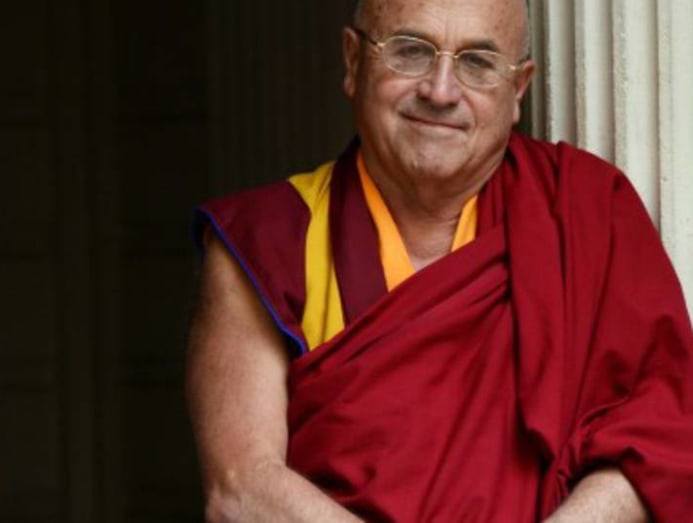
'I THINK WE SHOULD BE VERY HUMBLE'
Lunch does not normally feature prominently in my companion's routine. His late male parent wrote an anthology of gastronomy (Culture and Cuisine: a Journey Through the History of Food), simply, said Ricard, "I am totally the opposite. I do not remember 10 minutes after what I ate. I'1000 actually not interested."
I reach for my flask and pour a mug of steaming leek and potato soup. Ricard is vegetarian – "I don't desire to live on the suffering and the death of other animals" – and he has in front of him a simple salad starter of lettuce, grated carrot and corn blinis.
What does Ricard make of coronavirus and the global confinements to halt its spread? "I call back we should exist very apprehensive," he said. "There are people who have tremendous difficulties, financial difficulties, health difficulties, family difficulties. Information technology would exist pretentious to say anything well-nigh that because they are facing incredible hardship." Yet "there is a whole category of people who are doing quite OK materially" only who are still disoriented. A submicroscopic speck has overthrown united states, "shattering an illusion that modern man has built upwards."
The notion that nosotros can control external atmospheric condition is mistaken, he explained, gesticulating with a corn blini on his fork for emphasis. "We accept this very arrogant idea that we accept extracted ourselves from nature. We are masters of the universe, nosotros can send people to the Moon, we can dispense genes. It seems that we are invincible."
He is horrified, too, past the idea of transhumanism, and its adherents' quest to prolong dramatically the human lifespan. "Imagine Donald Trump being elected for the 50th fourth dimension or Lionel Messi scoring his 50,000th goal. How tedious!" I laugh in agreement. He went on: "I mean, I love my hermitage, but a thou years? As my mother likes to say, eternity is clumsily long, especially near the finish."
"We have this very big-headed idea that we have extracted ourselves from nature. We are masters of the universe, we tin send people to the Moon, we tin can manipulate genes. It seems that we are invincible." – Matthieu Ricard
THE PATH TO BUDDHISM
Ricard'southward path to Tibetan Buddhism began far from the Himalayas, in Savoie, south-eastern France. He grew upwardly in and near Paris, raised agnostic by parents who were at the centre of French intellectual life. His father, Jean-Francois Revel, was a political commentator who became famous for his challenges to both communism and Christianity; his mother, Yahne le Toumelin, is an abstractionist painter.
Through his parents' circles, Ricard'south upbringing was spent socialising with some of the not bad artists of the 24-hour interval: Andre Breton, the father of Surrealism, Russian composer Igor Stravinsky, and Spanish film-maker Luis Bunuel, to name but a few. "I was more interested in watching birds and playing music and football, but I was in that location at dinner so I saw them, and listened roughly to their give-and-take," Ricard recalled.
He struggled to find the function model he was looking for. "I realised later, when I tried to figure out why, that there was no correlation between their detail skills or genius and being a good homo beingness." He gives an extreme instance: One of his begetter'south best friends was the French Marxist philosopher Louis Althusser. "He became crazy and killed his married woman."
Ricard was 20 when he watched a documentary about Tibetan Buddhist masters and "saw that in that location were 20 St Francis of Assisi, twenty Socrates who were live today." He travelled to Darjeeling, in the Himalayan foothills, where his conversion to Tibetan Buddhism began. Ricard credits his mother with instilling in him an interest in "spirituality at large" during his childhood. In return he urged her to go to India to experience "a living tradition . . . not just in books." She followed his advice and, remarkably, also abandoned French bohemia and became a Tibetan Buddhist nun.
While Ricard completed a PhD in cell genetics at the Pasteur Found in Paris, each summertime he would render to the mountains. Every bit soon every bit he finished his doctorate in the early 1970s, he moved to the Himalayas.
It was through i of his teachers that Ricard first met the Dalai Lama, the spiritual leader of the Tibetan people. After several years of knowing each other, the Dalai Lama asked Ricard – who is fluent in French, English and Tibetan – to get his French interpreter. "It was wonderful because it's and then amazing to be with him intimately. The main thing is that the Dalai Lama is exactly the same with a caput of state and with the lady who cleans the hotel," said Ricard.
He recalled accompanying him to see the belatedly French president Francois Mitterrand at the Elysee Palace. "Normally, subsequently the meeting, you get in the machine and the president says goodbye and you lot become. But the Dalai Lama went all around the courtyard to shake hands with the guards, tap them on the shoulder, laugh with them. Mitterrand didn't know whether to stay or get back in." The Dalai Lama lives in India, in permanent exile from Tibet. Ricard won't be fatigued on Tibet's relations with China: "I really hope I can become dorsum to Tibet before I die."
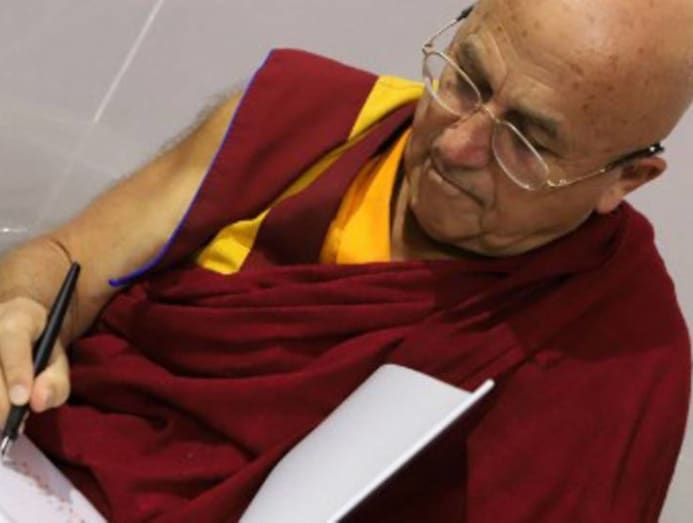
UNSOLICITED FAME
Information technology wasn't until 1997 that Ricard became a household name in France, when he co-authored a book with his begetter, The Monk and the Philosopher: A Father and Son Discuss the Meaning of Life. Information technology was framed as an e-meets-w discussion on the preoccupations that are equally onetime as humankind: The meaning of life, consciousness, freedom and suffering.
At the time, Revel was a well-known French thinker and journalist, but his son was a relative unknown. The volume became a bestseller in Europe and was translated into 23 languages. "That was a large change," he said. "It was either the showtime of my problem, or the commencement of an opportunity, I don't know.
"Information technology shows you how completely artificial celebrity can be because nobody knows anything virtually you and and then suddenly inside weeks they stop you in the street. I'thousand piece of cake to recognise considering I'm like a walking flag with this monk dress."
As nosotros finish our starters, nosotros turn to the theme with which he is perhaps virtually synonymous: Happiness. His 2004 TED talk "The habits of happiness" has been viewed more than than nine million times. In it, he makes the distinction betwixt happiness as something that can exist learnt and cultivated, and pleasure, which is anchored in time and identify, and exhausts itself every bit you experience it.
"There is a tendency today to look for hedonic happiness," he tells me, pointing to obsessions with status, wealth and image; and the growth of social media, which he describes every bit a "window for narcissism".
Hedonic happiness "usually ends up in failure. It is like a treadmill. You are never satisfied, you always want more. If y'all have ane, you want two."
Ricard advocates cultivating mental resilience and happiness – or what Aristotle called eudaemonia, the condition of human flourishing – by mind training through meditation. He took role in a report led by Richard Davidson, a neuroscientist at the University of Wisconsin-Madison that showed how meditation can, over time, alter networks in the brain and improve emotional and concrete wellbeing. Researchers hooked up Ricard'southward head to 128 sensors and constitute that when he meditated on compassion, he produced levels of brain gamma waves far outside the normal range, in areas of the brain associated with positive emotions, benignancy and wellbeing.
What does Ricard make of the "world'south happiest human being" moniker? "It'south the biggest joke in the world," he said. "How can scientists know about seven billion human beings' level of happiness? This is crazy. And there's no fashion you can compare people." He added: "I suppose it'south better to exist chosen that than the unhappiest person in the earth, but it still doesn't make sense."
He is oftentimes asked what is the "secret" to meditation. "There is nix highly mysterious about it, but it requires practice," said Ricard. "Any solution that is fast and easy, doable in five points and in iii weeks, forget it. It's like learning the piano, you take to exercise . . . There's no underground. It's a whole life, simply it's worth doing."
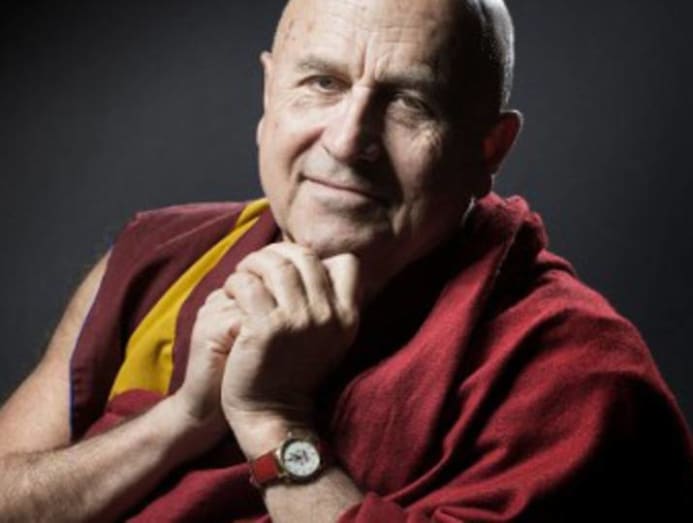
As lockdowns start to exist eased, policymakers face the claiming of trying to rebuild fractured economies. Some see this as an opportunity to promote a green economical recovery; others maintain that carbon taxes and policies damage growth and jobs, and call for putting the climate transition on hold.
Ricard is unequivocal: We accept to address climatic change – "the major challenge of the 21st century" – now. The benefits of quick and decisive action to tackle it far outweigh the economical costs of non acting.
Information technology has clouded over outside the hut; a pair of mallard ducks land on the loch below. Inside, my dejeuner guest is becoming animated, equally he outlines how the response to the public health emergency has shown that "governments and leaders can accept quite drastic measures and that people are ready to follow".
He added: "Then why can't they apply the same amount of determination to address even greater problems like the environment, climate change, global warming and loss of biodiversity? All of this is potentially a much greater cause of suffering."
His plea is for immediate action. "The future doesn't hurt, not still. The problem with the environs is that when information technology hits us badly, it'southward too tardily."
The moment is broken past the beep of Ricard's mobile, signalling that his battery is running low. "Oh wow, I've been heavy in consumption today," he laughed.
Conversation turns to the months ahead. Ricard has spent decades photographing and cataloguing Himalayan texts and paintings, and plans to return to the mountains in the fall. He has stepped dorsum from the day-to-solar day running of his xx-twelvemonth-old humanitarian foundation, which provides healthcare, education and social services in India, Nepal and Tibet. Now he is writing "a testimony of what it is to spend years with the neat Buddhist teachers".
"I don't take huge plans," said Ricard. "I'm 74 so it's time to go back to the hermitage. I don't want to die on an aeroplane, I want to have a few years of peaceful life. It'due south time to rejoice and prepare for death in peace and joy. A good death is the crowning of a skilful life, hopefully."
The sophistication with which he faces his side by side affiliate reflects the Buddhist conventionalities in decease as a natural role of the life bike. Many people in mod western societies are unprepared for decease considering "they have non pondered the fragility of human being life too much," said Ricard. "And they are not used to cultivating those inner qualities that make you face up decease with serenity.
"In Buddhism, nosotros think nearly expiry all the time. It is not morbid; it is merely to give value to every moment that passes by. Why practice so many people who have been given a yr left to live because of a terminal illness often say that it was the richest year of their life?" Because information technology draws into sharp relief all they agree precious, I suggest. "Y'all tin can appreciate that all your life," says Ricard. "That is the all-time manner. Thinking of expiry is just to appreciate every moment."
"In Buddhism, nosotros think about death all the time. It is not morbid; it is simply to give value to every moment that passes past." – Matthieu Ricard
Past Harriet Agnew © 2022 The Financial Times
READ> In an age of safe distancing, here'southward how to appreciate the joys of tiresome living

Recent Searches
Trending Topics
Source: https://cnalifestyle.channelnewsasia.com/people/what-can-we-learn-from-the-world-s-happiest-man-matthieu-ricard-247836
0 Response to "In these anxious times, what can we learn from 'the world’s happiest man'?"
Post a Comment